This guide focuses on ai coding assistants security compliance air-gapped requirements for finance, healthcare, government, and defense engineering teams. For general tool rankings, see our best AI coding assistants 2026 guide; for enterprise stack design, see the companion AI coding stack architecture notes in the same hub.
Why Most AI Coding Assistants Are Blocked in Regulated Environments
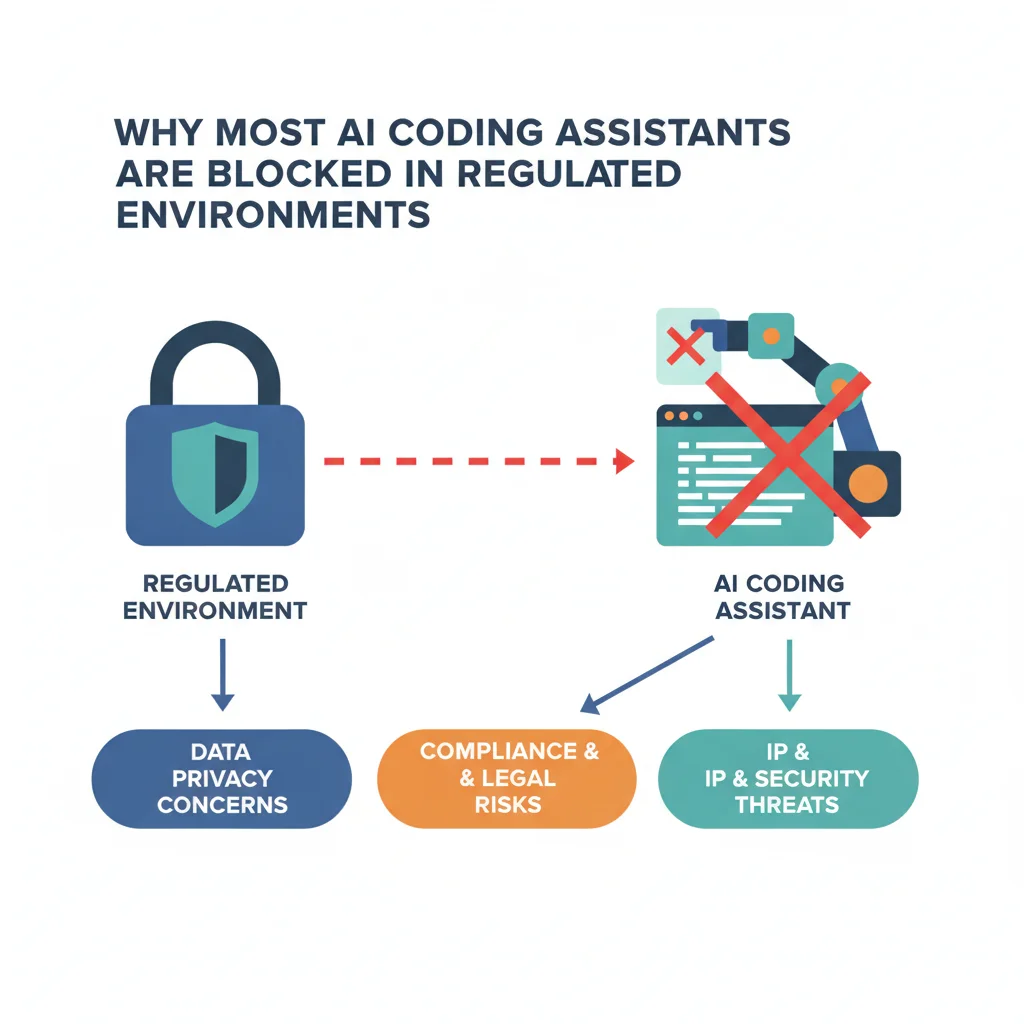
Organizations in finance, healthcare, government, defense, and other highly regulated industries face three main barriers that prevent them from using most popular AI coding tools:
- Data leakage and IP exposure: Sending proprietary code to third-party cloud services (Anthropic, OpenAI, etc.) creates unacceptable intellectual property and competitive risk.
- Compliance requirements: Many industries require SOC 2, HIPAA, FedRAMP, PCI-DSS, or other certifications that most AI coding tools do not have (or cannot provide contractual guarantees for).
- Air-gapped and on-prem constraints: Some environments are completely disconnected from the internet or have strict policies against any external data processing.
These constraints eliminate or severely limit Cursor, Claude Code (standalone), and most other tools that rely on sending code to third-party models.
Security reviewers are not being dramatic: a single thoughtless paste of proprietary logic into a consumer model can violate contractual confidentiality, export controls, or patient-data rules. That is why ai coding assistants security compliance air-gapped reviews start with data-flow diagrams, not feature checklists.
Even teams with private endpoints still ask whether prompts, telemetry, or fine-tuning logs could leave the boundary. Air-gapped programs add another layer: no outbound inference at all, which immediately disqualifies most developer-friendly assistants teams see in mainstream blogs.
1. GitHub Copilot Enterprise – The Most Viable Option for Many Regulated Teams
As of mid-2026, GitHub Copilot Enterprise is the only mainstream AI coding assistant that has successfully passed security and legal review in a majority of regulated organizations that have attempted to adopt one.
Procurement teams should still demand written answers on data residency, subprocessors, retention, and incident notification timelines. Engineering should map which repositories are in scope and which file patterns must never leave the boundary.
Successful rollouts pair Copilot with mandatory peer review, static analysis, and secrets scanning so AI speed does not outrun existing secure-SDLC controls.
Its advantages include: - Contractual IP indemnity and "does not train on your code" guarantees - Mature audit logging and policy controls - Strong enterprise governance features - Backing from Microsoft (which many regulated industries already trust)
Even Copilot Enterprise still requires thorough internal security review, but it is the tool that most often clears the bar when other options are blocked.
Legal teams gravitate toward Microsoft's indemnity language, training exclusions, and audit exports. Engineering teams appreciate that Copilot sits inside workflows they already operate. Neither group should treat approval as permanent—revalidate whenever models, data regions, or retention policies change.
Pilot design matters: start with low-sensitivity repos, require human review on every AI-authored merge, and log prompt categories so security can spot drift into regulated data classes.
2. Amazon Q for AWS-Based Regulated Workloads
For organizations that are deeply embedded in AWS and have strict compliance requirements, Amazon Q Developer remains one of the strongest (and sometimes only) viable options.
Its advantages include deep AWS service understanding, strong compliance certifications (SOC, ISO, HIPAA, PCI), and integration with AWS IAM and security controls. For AWS-native workloads in regulated environments, it is often the best technical fit.
Amazon Q is rarely the right answer outside AWS-centric estates. Inside them, it can shorten IAM policy work, CloudFormation refactors, and service-specific debugging—tasks where generic models hallucinate resource names.
Track transition risk: AWS continues to evolve its AI developer portfolio. Architecture boards should document fallback plans if SKUs merge or deprecate, so regulated workloads are not stranded mid-audit.
The main risk is the uncertain long-term future of the product as AWS transitions users toward its successor (Kiro).
3. On-Prem and Air-Gapped Options in 2026

Truly on-premises or air-gapped AI coding solutions exist but generally lag significantly behind cloud-based tools in model quality, context handling, and autonomy.
Vendors may claim on-prem parity, but regulated buyers should benchmark on their own repos: multi-file refactors, test generation, and framework-specific APIs are where gaps show up first.
Plan staffing as carefully as hardware—without internal champions, on-prem assistants become shelfware while developers quietly revert to forbidden cloud tools.
Organizations that require fully disconnected environments should expect to accept meaningful capability trade-offs. The gap between on-prem and cloud options is still substantial in 2026, though it is narrowing.
Most regulated organizations that can accept some cloud connectivity (with proper controls) are better off with Copilot Enterprise or Amazon Q rather than forcing a fully on-prem solution.
Self-hosted models can satisfy air-gapped policy but often lag on context length, tool use, and autonomous multi-file edits. Budget for GPU capacity, model refresh cadence, and a dedicated ML platform team—costs that rarely appear in consumer pricing pages.
Hybrid patterns are common: keep the most sensitive modules on-prem while allowing controlled cloud assistance on outer layers, provided legal signs off on segmentation and monitoring.
4. How to Evaluate and Get Approval for AI Coding Tools in Regulated Environments

The evaluation process in regulated industries typically includes:
- Security architecture review (data flows, encryption, access controls)
- Legal and contractual review (IP indemnity, data processing agreements, audit rights)
- Compliance mapping (which certifications and controls does the tool support?)
- Pilot with limited scope and mandatory human review of all AI-generated code
- Ongoing monitoring and governance processes
This process usually takes 3-9 months, significantly longer than in less regulated environments. Organizations should plan for this timeline and not expect quick wins.
Executive sponsors should set expectations with product teams: AI assistance is a controlled capability, not a default IDE feature, until legal signs the final packet.
Document decision criteria in writing so future tool swaps do not restart from zero—reuse evidence where subprocessors and data flows stay equivalent.
Frequently Asked Questions
Can any AI coding assistant be used in air-gapped environments in 2026?
Truly air-gapped options exist but lag behind cloud tools in capability. Most regulated organizations that can accept some controlled cloud connectivity are better off with Copilot Enterprise or Amazon Q after proper review.
Is GitHub Copilot Enterprise actually acceptable to security and legal teams?
It has been the most successful at getting through review in finance, healthcare, and government. The combination of IP indemnity, contractual protections, and mature governance features makes it uniquely acceptable compared to most alternatives. However, it still requires thorough internal review.
How long does security review typically take?
Expect 3-9 months for initial approval in regulated industries, depending on the organization's risk tolerance and AI governance maturity. This should be planned for and is significantly longer than in less regulated environments.
Are there competitive on-prem AI coding solutions?
Options exist but generally lag behind cloud tools in model quality and autonomy. Organizations requiring fully on-premises deployment should expect meaningful capability trade-offs.
What is the realistic path for most regulated organizations?
Most organizations in this space that have successfully adopted AI coding assistance in 2026 have done so with GitHub Copilot Enterprise (after thorough review) or Amazon Q (for AWS-heavy workloads). Truly air-gapped solutions are still limited and come with capability trade-offs.