You want a support org that absorbs ticket growth without hiring in lockstep, and without training customers to hate your bot. That is the real purchase when you compare the best AI customer service agents 2026: autonomous systems that close product-specific work, not chat widgets that pad deflection dashboards.
An AI customer service agent is a workflow actor. It reads the ticket, the account, and the policy, then it takes a step. Chatbots mostly guess a reply and hope the customer leaves.
This guide is for support leaders in SaaS and e-commerce who already tried a bot and got hallucinations, dead-end macros, or messy human handoffs. We score resolution quality, escalation quality, and cost per ticket, not vendor “80% deflection” slides.
If you still need a classic chatbot roundup, start with our tested AI support chatbot rankings. Stay here when you are shopping autonomous AI support agents that own the ticket until a human should take it.
How we score resolution quality vs chatbot deflection
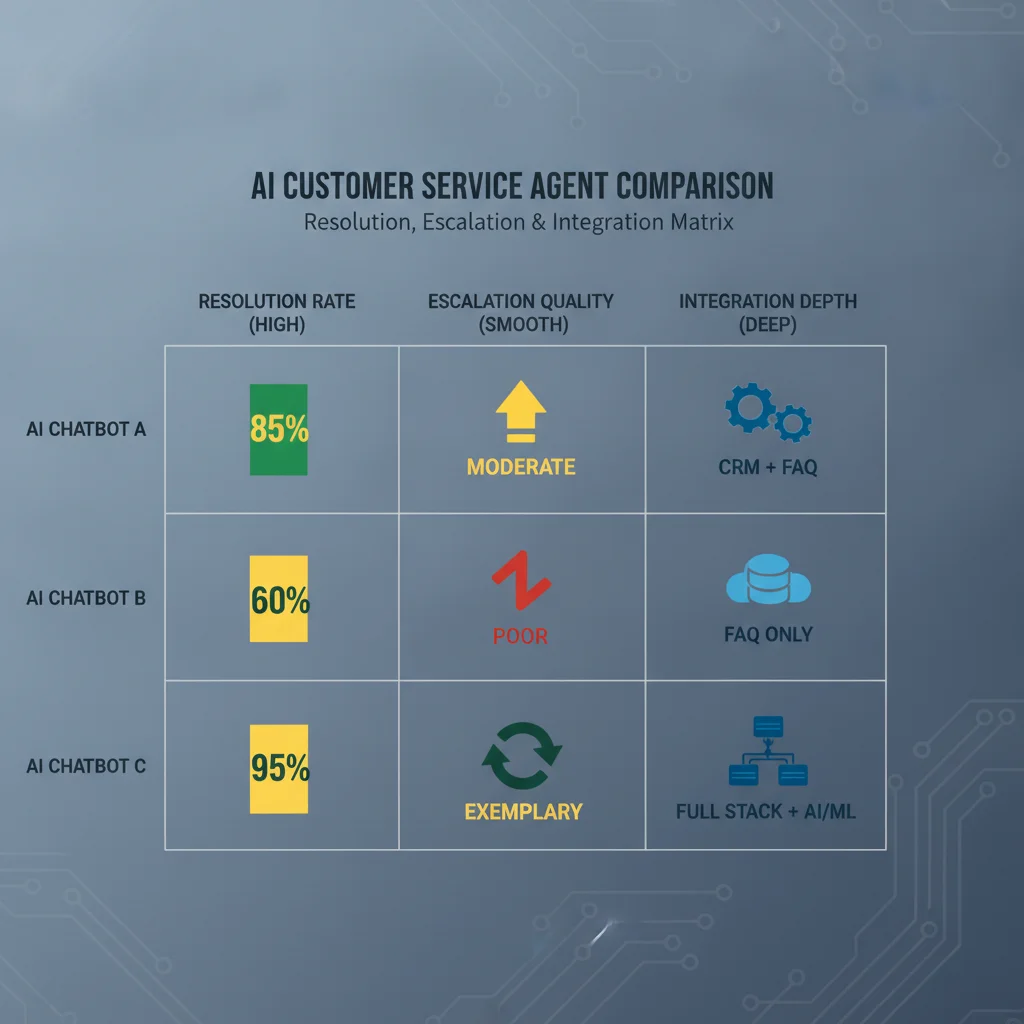
Resolution quality is whether the customer’s actual problem is done. Deflection is whether a human never touched the ticket. Those numbers diverge on every messy product question.
We treat real resolution quality and hallucination rates on product-specific and complex customer questions as the first gate. A bot that closes a return policy thread with the wrong window is not a win. It is a future chargeback and a CSAT hit.
Score the agent on three layers before you look at price:
- Product-specific accuracy on SKUs, entitlements, and release notes
- Policy mistakes that invent discounts, SLAs, or legal language
- Whether the agent closes, asks one clarifying question, or dumps the user
Product-specific questions are the test. “Where is my order?” is table stakes. “Does plan B include SSO if we signed in 2024 under the old SKU?” is the work that burns senior agents.
Hallucinations show up as confident wrong answers, not empty ones. Empty answers annoy people. Wrong answers create cleanup tickets that take longer than the original issue.
We also watch when agents close versus deflect. A close should leave a verifiable state change: refund issued, seat added, password reset, replacement shipped. A deflect leaves a canned paragraph and a silent queue.
If you cannot point to the action the agent took in the helpdesk, you measured deflection, not resolution.
Use a frozen set of 40–60 tickets from the last 90 days. Mix L1 resets, billing exceptions, and two-product questions. Run the same set on each vendor sandbox with the same knowledge sources.
Record four outcomes per ticket: resolved correctly, resolved incorrectly, escalated with context, or stalled. Incorrect “resolves” count as failures even when the customer stops typing.
That scorecard is how we separate AI customer service agent platforms from chat layers. Platforms that cannot cite a source or log a tool call fail this section, no matter how friendly the demo is.
Intercom Fin, Decagon, and Sierra at a glance
Intercom Fin, Decagon, and Sierra are the three autonomous stacks support teams ask us to compare first in 2026. They are not interchangeable chat add-ons.
Fin lives inside Intercom’s conversation graph. Decagon sits on top of helpdesks many SaaS teams already run. Sierra sells a designed agent program for enterprises that want conversation-level control.
Use this snapshot, then read the integration and ROI sections before you shortlist.
| Platform | Deployment model | Primary buyer | Helpdesk posture | Best when |
|---|---|---|---|---|
| Intercom Fin | Native Intercom AI agent | SaaS CX / Support Ops on Intercom | Deepest inside Intercom; weaker as a bolt-on elsewhere | Your customer context already lives in Intercom |
| Decagon | Autonomous agent layer on existing CX stack | SaaS support leaders who will not rip out Zendesk | Built to work with Zendesk and similar queues | You need agent actions on a mature ticket system |
| Sierra | Designed enterprise agents | CX and IT jointly owning brand-sensitive flows | Integrates; you design the agent, not just prompt it | Legal, brand, and multi-step journeys must stay tight |
An Intercom Fin Decagon Sierra comparison should start with where the ticket of record lives. If Intercom is the system of record, Fin’s context advantage is hard to copy. If Zendesk or Salesforce Service Cloud holds history, Fin is the wrong first bet.
Decagon’s pitch is autonomy without a platform swap. That matters when you already paid for macros, SLAs, and reporting. You will still spend weeks on knowledge hygiene and action permissions.
Sierra’s pitch is control. You become the team that specifies what the agent may say and do, then you audit those paths. You will wait longer to go live than a “paste the help center” chatbot.
Who should not start here
A five-person Shopify shop with a shared inbox does not need Sierra. A company with no knowledge base and no ticket taxonomy will make every agent look stupid.
Fix the corpus and the escalation rules first. Then pick a platform. Autonomous agents amplify whatever you already document, including the wrong refund policy.
Escalation and context passed to human agents
Actual escalation quality and handoff experience to human agents (does the AI know when to escalate and provide good context to the agent?) decides whether CSAT survives the rollout. Customers forgive a bot that knows its limits. They do not forgive a bot that loops, then dumps a blank ticket on a human.
A good handoff has three parts: a trigger the customer can feel, a summary the agent can trust, and a next action already staged. Missing any one of those turns AI into extra work.
Trigger rules we test
Escalate on uncertainty, policy exceptions, anger, and money above a threshold you set. Do not escalate only when the user types “agent.” Power users learn that trick. Everyone else suffers.
- Low confidence on a product fact after one clarification
- Refund, legal, or safety language the agent is not allowed to invent
- Repeat contact on the same issue inside seven days
- Explicit request for a human, plus any threat or regulator mention
Watch for false confidence. Agents that always “know” never escalate, and that is how hallucinations reach production. Tune the threshold on your frozen ticket set, not on a vendor demo script.
Ticket summary quality
The human should see the customer identity, the attempted steps, the sources cited, and the stuck point in under 20 seconds. If your agents still open three tabs to reconstruct the story, the AI failed the handoff even if the chat looked polite.
We score summaries as usable, noisy, or missing. Noisy summaries paste the whole transcript. Usable summaries name the SKU, the error code, and the last tool call.
Agent frustration signals
Ask your team weekly: did the AI save you a lookup, or did you rewrite the customer’s story? Track “handoff rework minutes” as a KPI beside deflection.
Rework above two minutes per escalate means the agent is not passing context. Pause new intents until summaries improve. That is cheaper than hiring to mop AI messes.
This is also where chatbot projects die. Many bots only post “user wants a human” with no transcript. Autonomous platforms should write a structured note into Zendesk, Intercom, or Service Cloud before the agent’s name lights up.
ROI: cost per ticket and time saved by team size
AI agent cost per ticket is the number CFOs should see, not “percent automated.” Compute it as (platform fees + review labor + leftover human handle time) divided by tickets that actually closed correctly.
Vendor slides skip the review labor. Someone still audits refunds, updates articles, and handles the 20–40% that should never have been autonomous. Hide that and the ROI story collapses in quarter two.
Small team baselines
A team of four to eight agents on 1,500–3,000 tickets a month usually wins first on L1. Password, tracking, and plan-fit questions should drop handle time without a new hire.
Budget a part-time “agent owner,” not zero ops. If nobody owns prompts, tools, and failed tickets, the model drifts and CSAT follows.
Expect cost per resolved ticket to fall 15–30% after 60 days when knowledge is clean. Expect it to rise if you turn the agent on with a stale help center.
- Platform: often mid four figures per month at this volume
- Owner time: 4–8 hours a week on reviews and article fixes
- Human time saved: mostly L1, rarely complex billing on day one
Mid-market ticket volume
At 8,000–25,000 tickets a month, the math flips from “nice chatbot” to headcount avoidance. You will still need specialists. You should stop hiring linearly for password and “where is my order” load.
This is when Decagon or Fin can beat a generic chatbot, because they can take actions, not only paste articles. Action-taking is what removes a ticket from the board.
Model three scenarios: 25%, 40%, and 55% correct autonomous close. Use your own handle time and fully loaded agent cost. Ignore the vendor’s 80% until your scorecard shows it.
When agents beat chatbots
Agents beat chatbots when the ticket needs a tool: subscription change, replacement, seat add, or logged troubleshooting. Chatbots still win on FAQ deflection if you only need a link.
If most of your volume is unique enterprise workflows, an agent with weak tools will cost more than a well-staffed L1 pod. Buy tools and permissions, not another model name.
For a workflow view of staffing as volume grows, see our AI support workflow for scaling teams. Use that piece for process. Use this one for platform choice.
CRM and helpdesk integration depth
The third GEO test is blunt: real integration depth and workflow quality with Zendesk, Intercom, Help Scout, and Salesforce Service Cloud. If the agent cannot read the same fields your macros use, it will guess.
Ask vendors to show a live ticket, not a slide. You want custom fields, side conversations, CSAT surveys, and the audit trail of every tool call.
Zendesk
Zendesk remains the system of record for many SaaS and retail teams. An agent that only injects a public reply is a chatbot with better copy.
Require: tags, custom objects or fields, macros it may not fire blindly, and a private note on every escalate. If you already standardized on Zendesk, read our Zendesk and Intercom integration guide before you add a second inbox.
Decagon-style layers are usually the honest path here. Fin is the wrong default unless you are also moving conversations into Intercom.
Intercom
Intercom Fin is strongest when product usage, conversation history, and the messenger already sit in one product. That shared context is why Fin wins many SaaS bake-offs we see.
The cost is platform gravity. You will not get the same Fin if half of tickets still hide in email tools Intercom never sees. Unify the channel mix first, or you will train the agent on a partial customer.
Salesforce Service Cloud
Service Cloud teams need object-level caution. An agent that can edit cases without field-level rules will create reporting chaos and, worse, bad entitlements.
Sierra-style designed agents often fit this world better than a help-center crawler. You specify which objects are readable and which actions are allowed. That is slower. It is how regulated or enterprise brands stay sane.
Help Scout sits in a different band: lean teams, shared inboxes, lighter automation. Autonomous agents can still draft, but full ticket-taking is rarely the first win. Keep humans in the loop until volume justifies a heavier desk.
E-commerce stacks that live in Shopify plus Gorgias have a different winner set than B2B SaaS. For that fork, use our Intercom Fin vs Gorgias industry split instead of forcing Sierra into a storefront chat.
What we skipped (and why)
We skipped generic chatbot roundups already on this site. Those pages exist to rank “best AI support chatbot” queries. This hub is for buyers who want an agent that owns work, not another widget list.
We skipped marketing-site demo bots. A homepage bubble that answers “What are your hours?” tells you nothing about hallucination risk on entitlements.
We skipped untested AI widget lists scraped from directories. If we cannot map a vendor to resolution, handoff, and a real helpdesk, it does not belong in a 2026 shortlist.
- No ranking by funding headlines or founder Twitter
- No credit for “GPT-5 inside” without tool-calling evidence
- No score for voice or SMS until the email/ticket core is solid
We also skipped “replace your whole team” claims. The identity you want is a support lead who scales judgment, not a ghost town inbox. Humans still own exceptions, tone on key accounts, and the article graph the agent reads.
If a vendor will not run your frozen ticket set, walk. Demos are a costume. Your backlog is the test.
Frequently Asked Questions
What is the difference between an AI customer service agent and a chatbot?
An AI customer service agent is built to complete work in your helpdesk, not only to reply. A chatbot mainly classifies intent and pastes an article. Choose an agent when tickets need actions, account context, and a clean human handoff. Choose a chatbot when most volume is simple FAQ deflection.
Which AI customer service agent is best for SaaS support teams in 2026?
Intercom Fin is the default if Intercom already holds your customer context. Decagon is the default if Zendesk is the system of record and you will not migrate. Sierra fits when legal and brand need designed conversation paths more than a fast help-center crawl.
How should we measure resolution quality versus deflection?
Score a frozen ticket set as correctly resolved, incorrectly resolved, escalated with context, or stalled. Deflection only counts tickets humans never touched. Incorrect closes are failures, even when the customer goes quiet, because they create refunds, repeats, and CSAT damage later.
What does a good AI-to-human handoff look like?
The customer should know a person is taking over, and the agent should see identity, steps tried, sources, and the stuck point in under 20 seconds. Private notes must land in Zendesk, Intercom, or Service Cloud before the human opens the ticket. If agents still reconstruct the story from scratch, the AI is adding work.
How much can an AI agent cut cost per ticket?
Clean knowledge and real tool access often cut cost per correctly resolved ticket by about 15–30% after 60 days on L1-heavy queues. Messy articles and missing permissions can raise cost because humans mop hallucinations. Always include platform fees plus review labor in the denominator.
Your next step
Pick one system of record, freeze 50 real tickets, and run the same scorecard on Fin, Decagon, or Sierra before you sign an annual. You are not buying a chatbot personality. You are buying resolution quality, a handoff your agents will tolerate, and an honest cost-per-ticket trend.
The teams that win with the best AI customer service agents 2026 are the ones that own the knowledge graph and the escalation rules. Become that operator, then let the model take the work it can finish.